Estimate dishwasher eco electricity from the 100-cycle figure
Scale the label value to your planned use and keep electricity separate from water and purchase costs.
Updated:

Use the eco-programme basis correctly
Energy Saving Trust explains that dishwasher label electricity consumption is shown for the eco setting per 100 cycles. Preserve both the unit and the programme basis in your notes. A number copied without those details can be mistaken for annual use or the consumption of every available programme.
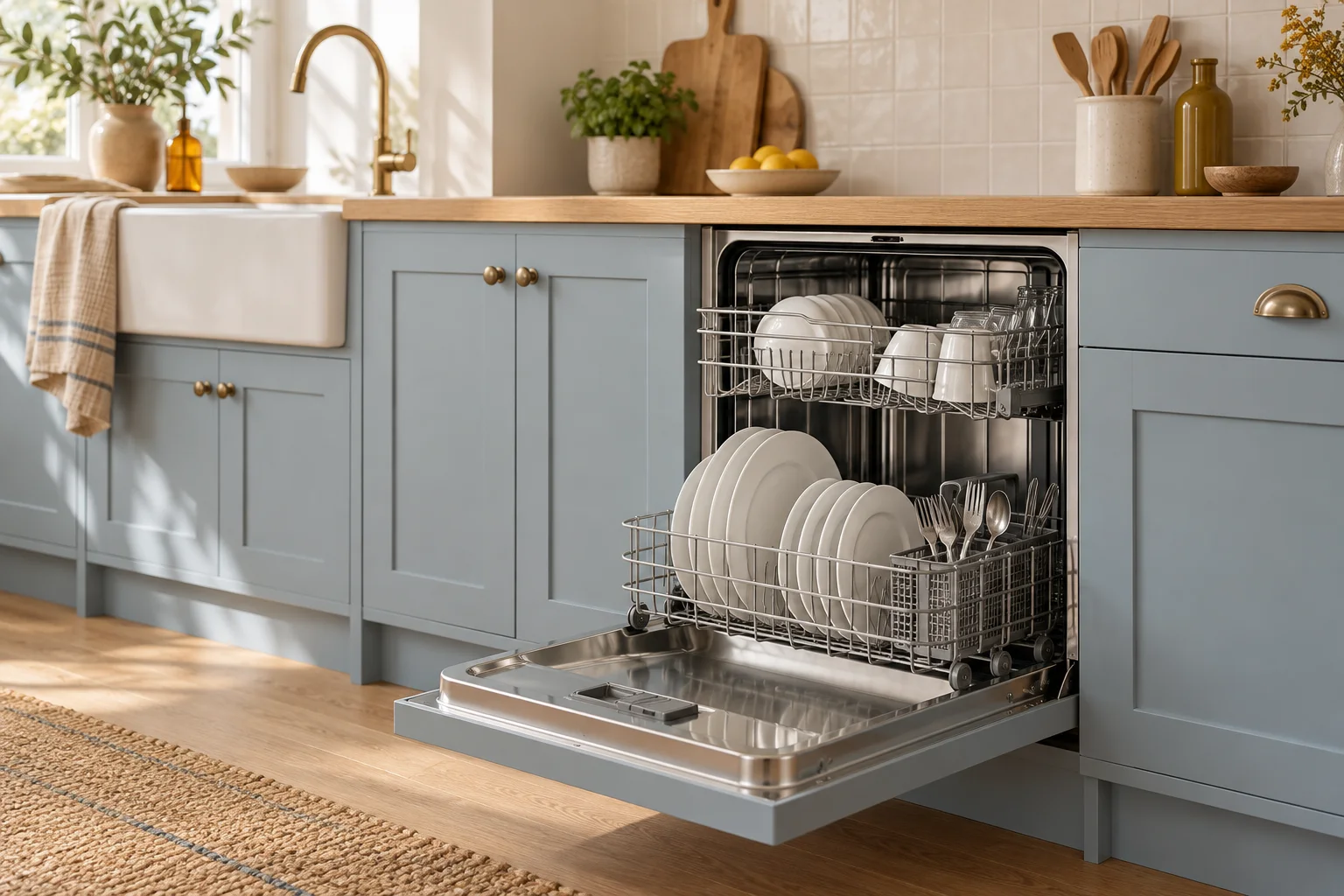
The historical open dishwasher photograph is visual context for the appliance, not a current energy-label example. Obtain the actual label and product sheet for the shortlisted model. Do not assign a consumption figure to an older machine because its size or rack arrangement resembles the one you are considering.
Energy Saving Trust: home appliance labels ?
Scale the value to your planned count
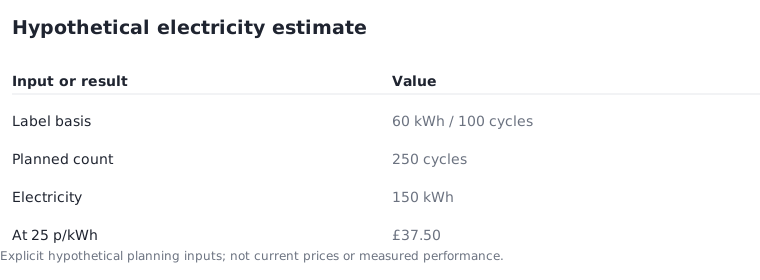
Assume an invented label figure of 60 kWh per 100 cycles. For 250 planned cycles, multiply 60 by 250 and divide by 100, giving 150 kWh. At an assumed 25 pence per kWh, the resulting electricity estimate is £37.50. These are hypothetical inputs, not a current product specification or tariff.
Keep the planned count explicit. If you use a weekly estimate, state the number of weeks as well as cycles per week. A calculation based on five cycles over 50 weeks contains 250 cycles; it should not be described as a measured annual routine unless you actually have a record supporting it.
Do not turn the estimate into a programme test
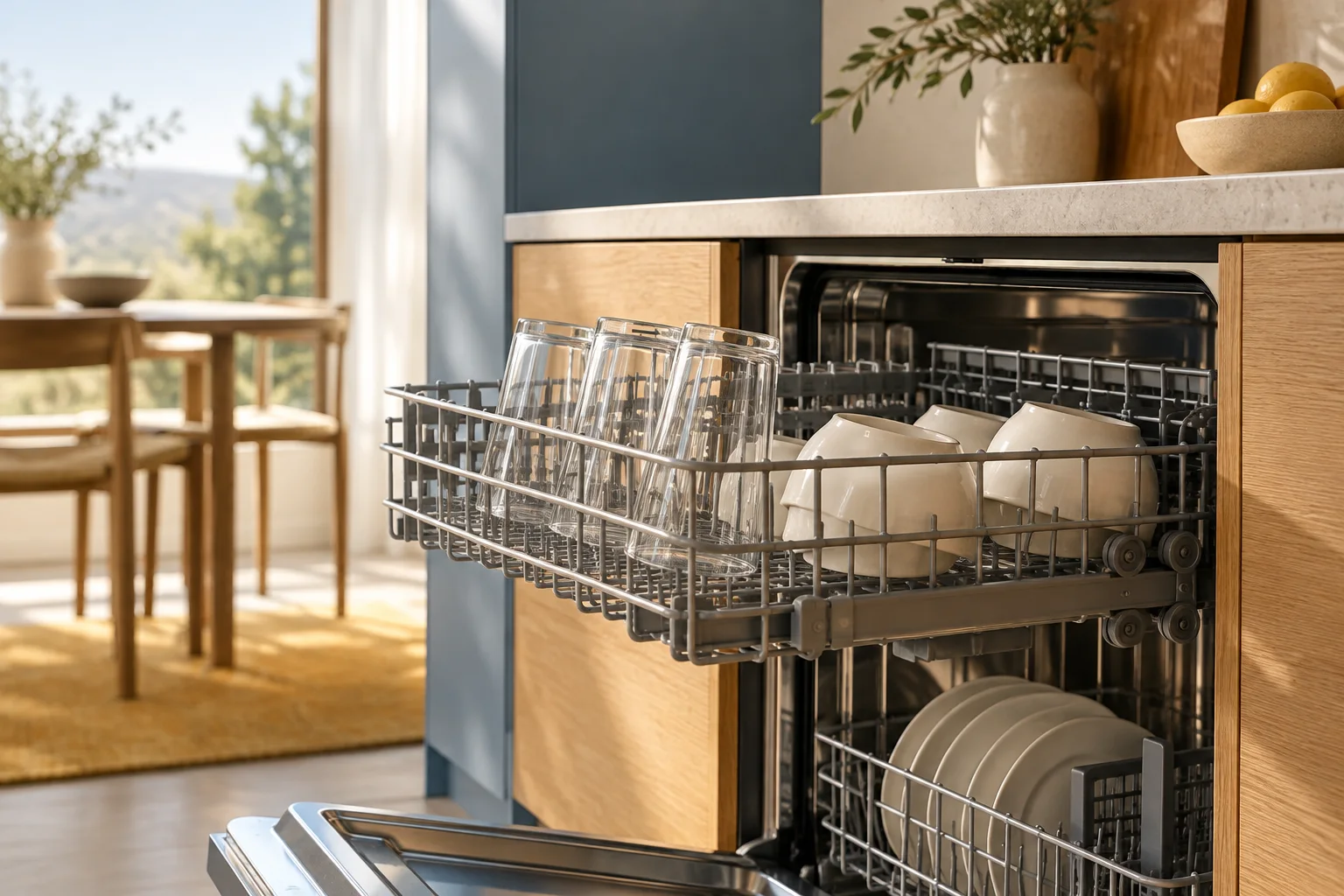
The calculated total scales a stated input; it does not measure cleaning performance or the electricity used by your own loads. The KitchenAid rack photograph shows items of different shapes, reminding us that a real load has characteristics absent from a simple arithmetic example.
Use the exact machine instructions for loading and programme selection. This guide does not claim that every short, intensive or automatic programme has the same consumption as the label's eco basis. If a comparison depends on another programme, obtain the appropriate manufacturer information rather than substituting the eco figure silently.
Keep water and other spending separate
Energy Saving Trust notes that dishwasher labels also show eco water consumption and duration. Those fields should remain distinct from electricity. A total expressed in pounds for electricity alone does not include metered water charges, detergent, maintenance, purchase or installation.
The compact dishwasher photograph illustrates another format that still needs its own information. It is not automatically cheaper to run because it is smaller, and no test result is inferred from it. For an assumed water figure of 9 litres per cycle over 250 cycles, the arithmetic total is 2,250 litres or 2.25 cubic metres; any cost needs the relevant tariff and scope.
Energy Saving Trust: home appliance labels ?
Compare a clear pair of scenarios
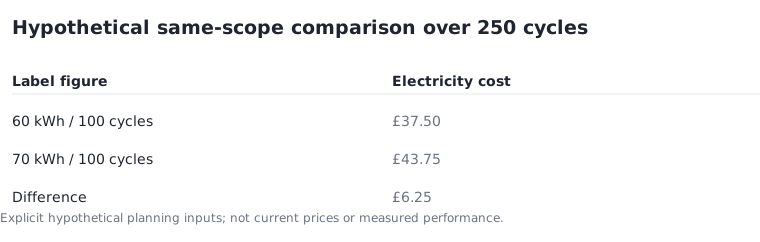
For a hypothetical comparison over the same 250 cycles, label inputs of 60 and 70 kWh per 100 cycles produce 150 and 175 kWh. At 25 pence per kWh the estimates are £37.50 and £43.75, a £6.25 difference. This does not establish a replacement saving or payback period.
Save the model's product information sheet, which GOV.UK identifies as part of the regulated information, with your assumptions. Check that capacity, programme scope and intended use are comparable before treating the difference as useful. Update the calculation when the tariff, planned cycle count or model changes.
GOV.UK: energy information and current tumble dryer labelling ?